
Ben Hall Family 1802-1977
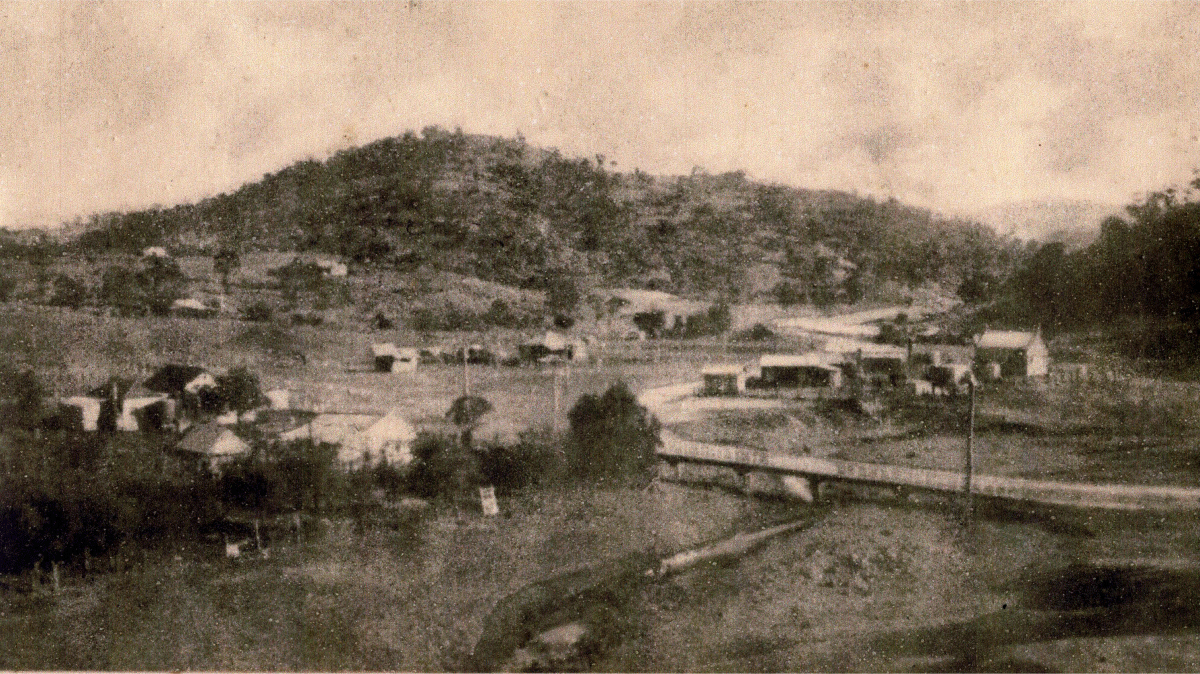
From well out on Liverpool Plains he turned southward keeping to the west of the boundaries of the settled counties until he came to the Lachlan district between Carcoar and Forbes where it seems that he obtained employment and remained .
He was completely out of communication with his family for while he could write Eliza could not read and if she took the letter to someone to read to her there was the possibility that the reader might inform the police. Apart from this as this was before prepaid post it is likely that advice of the receipt of a letter at the post office might have resulted in the police being informed of its arrival. The only means of communication would be by verbal messages passed on until they reached Eliza and such messages would be vague and general.
Returning to events of July, 1845, on the visit by the Clerk of Petty Sessions and police to Doughboy Hollow stock, mostly horses were seized. On 26th July, the police mustered Doughboy Hollow and recovered at least 12 horses which had been stolen. Of these at least two were Mr J.K. Abbott's horses another belonged to W. Buchanan (who resided on the south side of Aberdeen) another to Robert Pringle of Summer Hill (near Tamworth) then there were horses belonging to Donald McDonald and Alexander Brodie.
On August 2, 1845 the warrants for the arrest of both Benjamin and Alexander Paterson were advertised and these advertisements were followed by advertisement offering a reward of £15 (equivalent to about $3750 nowadays) for the capture of either of them plus in the case of a prisoner the issue of a ticket of leave. Paterson was arrested at Kiama on 31st December but no information as to what had happened to him is available.
Eliza who had given birth to a son Henry on 12th February, 1845 was left with the children to fend for herself with what cash Benjamin may have left at the house. She and the family did not leave Murrurundi as she was engaged in litigation as defendant and complainant at the end of 1845 and at the beginning of 1846. On August 31, 1845 she had her son Henry christened at St. Joseph's. In 1846 she applied for her certificate of freedom and obtained it from the Murrurundi Court on September 10. Also in depositions of police officers relating to matters which occurred in 1846 and 1847 she is referred to as a resident and a seller of cows.
She must have obtained the services of someone to apply for her certificate of freedom who could well have been the visiting priest Rev. J. Lynch or perhaps Thomas Haydon who was the unofficial leader of the Catholics of Murrurundi.
Thomas Wade, the eldest of her children could have mustered stock on the squatterage and brought them to Murrurundi. Mary the eldest daughter could have looked after stock in the Haydonton area, milked cows and assisted in the garden and house. William could clearly also have ridden to the squatterage as might be necessary besides assisting at Haydonton. The next boy Edward who would have been nine could assist in the garden and in handling the milch cows. Young Benjamin could similarly have assisted though only eight but Catherine and Robert would both have been too young to be of any help and there was the baby Henry.
The produce of livestock, milk, butter and vegetables and fruit in season all of which was produced on the squatterage or Haydonton lands would have enabled Eliza and the family to carry on. In addition she developed another source of income by offering the three rooms of her house for rent and moving the family into the kitchen and blacksmith's shop. Also she may have offered to carry out domestic chores including cooking for the tenants.
The first tenant was R.H. Milner a medical practitioner who was trying to establish himself on a run on the Namoi River . He became a tenant in 1846 or slightly earlier and left before mid 1846. He was followed by another medical practitioner Charles Hallett who established the first medical practice in Murrurundi. When he died in 1847 R.B. Welsh also a medical practitioner became a tenant and remained until 1848 when he moved to Tamworth. He was also the holder of Doughboy Hollow Run.
In the Lachlan area Benjamin was working under an assumed name but in 1848 he was recognised by a trooper and arrested on October 18. He was brought in to Bathurst and on October 23, was sent to Murrurundi. The trip from Bathurst to Murrurundi would have taken about three weeks. At Murrurundi he was placed in the lockup (see below) and refused bail.
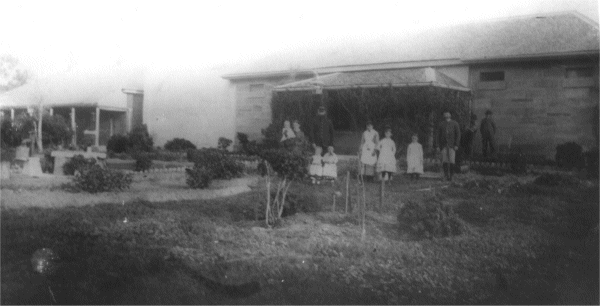
The court officials then set about getting together the evidence against him. In this task they were in difficulties for J. K. Abbott had died and other witnesses could not be located. Also the Attorney General advised the magistrates that William's evidence could not be used against his father.
The months dragged on and Eliza complained to the Attorney General about the Murrurundi magistrates' refusal of bail. Once again there is the question of who wrote the letter for her. Again it could have been either of the persons already mentioned or a third person Rev. Fr. Rigney the priest at Whittingham who at this time was regularly visiting St. Joseph's. Whoever it was, the letter was successful in having the Attorney General directing the magistrates (of whom Thomas Haydon was now one) bail should be granted. Bail was granted on April 3, 1849. By that time the family was once again occupying the whole of the house.
After all available evidence against Benjamin was collected the Attorney General advised that he did not consider the evidence sufficiently cogent to put Benjamin on trial and in June, 1849 the case against him was dismissed.
In 1849 it seems that Benjamin decided to abandon his squatterage on Ben Hall's Creek probably because at that time he could only have continued to hold it had he applied for and obtained a licence from the Crown to do so. In all probability had he applied his reputation was such that he would have been refused.
Some time in the second half of 1849 Benjamin appears to have returned to the Lachlan district where he may have been offered employment at Green's UAR station about 12 miles from Forbes. He also found that there would be no difficulty of obtaining land there.
While he returned to Murrurundi in 1850 he had resolved to move his family to the Lachlan district. However Eliza who was then pregnant objected to moving both on the ground of the long and tedious journey to get to the Lachlan area and that she and the children would be returning to primitive conditions she had endured in the late thirties and forties. This argument was made stronger by the fact that the Haydonton house was for the times comfortable and it was in a developing town with shops in Haydonton close to the residence and in Murrurundi within walking distance.
It appears that for much of 1850 Benjamin was in Murrurundi as he is reported to have had a racehorse named Jacky Jacky that did well on the second Murrurundi race course which was within the town and finished in Mayne Street in the vicinity of the former Hospital site (now Bowling Club) and this course was abandoned by 1853. Also in October, 1850 Benjamin signed a recognisance to be of good behaviour at the Murrurundi Court
Benjamin and Eliza's last child, a girl Ellen was born on 19th June, 1850 but as her baptism was delayed until 1854 it is likely that Benjamin had left Murrurundi for the Lachlan are before the end of 1850.
On this trip the family was divided for Edward, Catherine, Robert, Henry and Ellen remained in Haydonton with their mother while Thomas Wade, Mary, William and Benjamin went with their father.
Edward who would have been 14, Catherine about 12 and Robert eight could have helped their mother to manage the Haydonton property.
On this occasion Benjamin and his section of the family took with them horses and cattle for sale on the journey and at their destination.
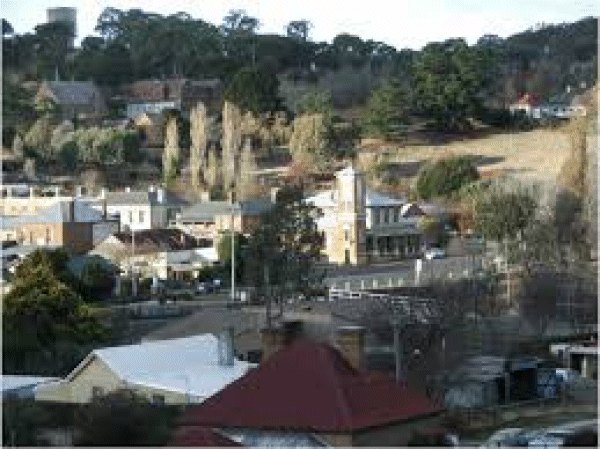
While in the Lachlan area, possibly not far from Carcoar (above), Benjamin and his sons Thomas, William and Benjamin obtained employment on local properties and Mary married William Wright an ex-convict much older than she at Carcoar on 16th November, 1851. It appears that after the marriage Thomas remained with Mary and her husband who was a small settler.
If Jack Bradshaw's story as to the meeting of Benjamin Senior and Junior with the bushranger Frank Gardiner on the road between Binalong and Goulburn and Benjamin junior being fascinated by his stories is correct, it must have taken place in this period.
Having seen Thomas, William and Benjamin placed in employment and Mary married, Benjamin returned to Haydonton at the end of 1851 as he is shown as a resident of Haydonton on the electoral roll of February, 1852.
By this time the Colony had completely recovered from the depression of 1842-3, prices for wool, sheep and cattle were good and in this year also the gold mining boom began.
Late in 1852 gold was discovered near the site of Nundle and by early 1853 a third of the male population of Murrurundi and Haydonton was on the diggings. Whether Benjamin and possibly Edward went to the diggings is not known. Whether they did or did not, they quickly discovered that money could be readily made by selling meat and vegetables to the miners and this they undoubtedly did.
According to family report, Henry was, apart from Benjamin, the only member of the family who could read and write. The National School was opened in Murrurundi in 1849 (it stood when built on part of the lands of the Public School) but though in 1852 he would have been seven years old his name does not appear on the list of pupils at that school in November, 1852. It is quite possible he attended that school in 1853 or 1854.
There is another possibility also. In 1853 a Mr. Thomas opened a grammar school in a newly erected cottage opposite the Hall's residence (the building now known as Bridge House). Henry could have attended that school though the fees for tuition there would have been much greater than those at the National School.
The period 1852-54 appears to have been one of prosperity for the Halls though Benjamin had very little land, yet he could have run cattle and horses on Murrurundi common which was much bigger then than it is now or obtained agistment on Mr Haydon's Haydonton lands or on Mabyn Vale and the unallotted Crown lands behind them.
Early in 1854 Mr. W.H. Warland of Harben Vale decided to subdivide part of his lands then known as Warland's Flat to create a number of farms and a village. The village is Blandford.
Back to the contents