
Signalman White's Appeal UpheldAt a sitting of the Railway Appeals Board held at Newcastle last week Walter Francis Maitland White, signalman at Murrulla on the 13th September last, appealed against the findings of the Department that he had failed to see that proper arrangements were made for the coupling of the vehicles on Train No 62, the rear portion of which ran away and crashed into No 8, the North-West mail, causing the death of 27 passengers.
|
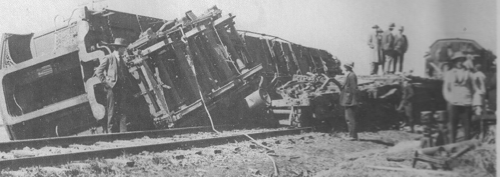
DISASTERIN THEVALLEY OF DEATHAnd for 27 people in 1926, |
To the crew and five carriage loads of passengers, it was just another routine trip from Moree to Sydney . . . a tiring journey that seemed to get nowhere. But in the gloom of that dark night, the crisp Valley air hinting at a thick morning frost, death was about to plunge upon the hapless men, women, and schoolchildren without warning, without pity. The Mail was snaking its way through "The Valley of Death" ~ the hoodoo section of Valley railway system that had mysteriously claimed five lives and injured many in two previous accidents only weeks before. No one on the Mail that night knew they had a date with death in what was to become one of Australia's worst rail disasters, leaving 27 dead and even more badly injured. Most of the passengers were asleep at 11.20 that night as the train left Murrurundi. But Sydney telegraphist Garnet Wilson, and Moree couple Mr and Mrs C. A. Kay were wide awake and talking nervously about the tragic fates of the Brisbane Express and a goods train that crashed off the tracks in the same area only recently. |
The Mail |
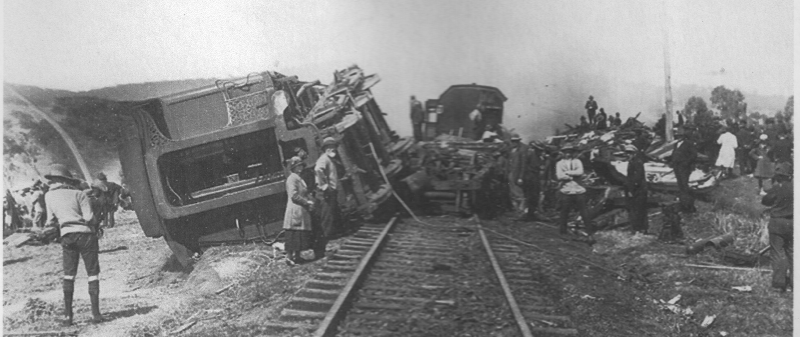
Mrs Kay said "Yes, it will be the North West Mail next." Her fantastic prediction became nightmare reality only five minutes later, according to Mr Wilson's interview with a "Newcastle Sun" reporter the next day. The group shut their eyes and tried to rest. It wasn't easy as the train jerked along the tracks, clicety clacking, minds restless about train voodoos in that so-called "Valley of Death." The Mail gathered steam for a long incline just a mile out of Murruruodi, steel wheels gripping an endless length of iron track that wove its way through hillsides cloaked in trees and gullies. |
A preminition |
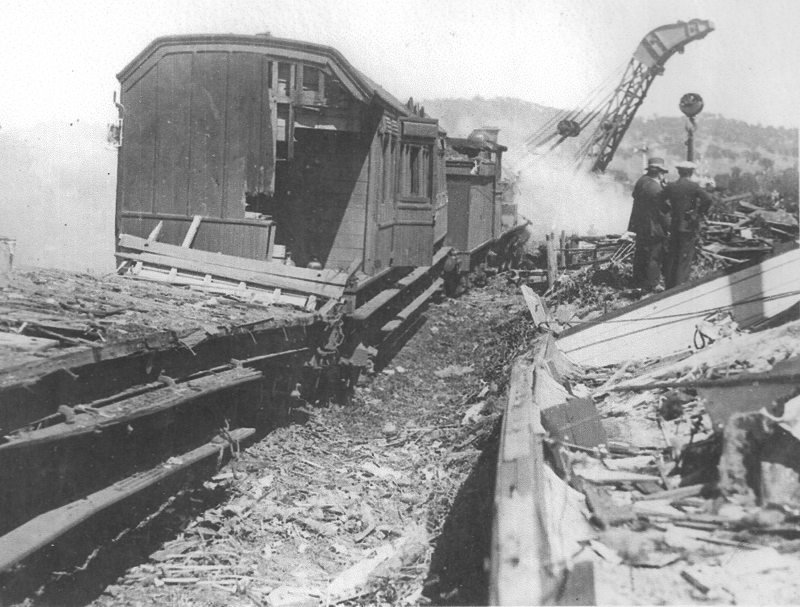
The moon was high. It was a clear night. A silent night. The train had barely travelled a 100 feet up the incline when disaster struck, raining instant death and terrible injuries to those on board. The force that hurled ihe two P-class locomotives and lenders off the tracks, completely wrecking the first, came out of the night with devastating impact. One complete carriaige was crushed like an egg-shell, levelling it to the floorboards and twisted wheels. The force was five runaway iron trucks laden with 600 tons of wool. |
The night |
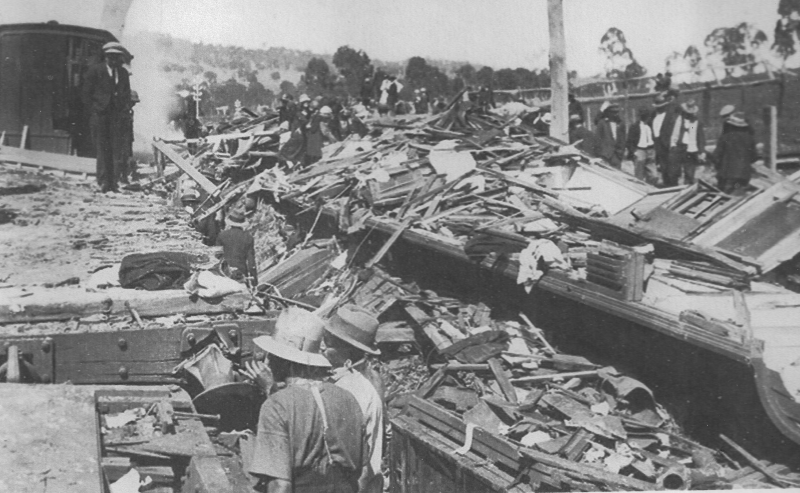
They broke free from their coupling at Murulla siding and careered 1½ mile out of control down the hill into the on rushing North West Mail. Then chaos! Frail timber framework from carriages splintered into thousands of fragments, buckled and jagged iron ripped through smashed wooden partitions, reducing sleeping compartments and "dog boxes" to rabble. Agonised screams pierced the night, engine boilers exploded, bales of wool burst into flames and timber caught fire from the heat. Many were killed instantly ~ not knowing what hit them. Others died agonisingly in the blackness, crushed by wreckage. |
Wooden |
Only a few escaped from the second class carriage that was reduced to nothing. They were thrown clear and were badly injured. Garnet Wilson was among the lucky in another carriage. An open window saved him. "I reckon I was the luckie&t man on board that train, he said afterwards, "all the way down I kept trying to shut the window but it wouldn't stay shut," he said. "Because it was open I was able to edge my way out inch by inch by struggling. I heard Mrs Kay near me and I helped her . . . we couldn't find her husband." Only minutes earlier Mrs Kay had said the North West Mail "would be next." She was snapped out of her doze by fhe impact that almost broke her neck."Oh my God!" she cried out, "I am killed." |
I am killed |
Farmers within a range of three miles heard the crash and lights went on. Phones buzzed the shaky, pitiful message. Rescuers raced to the scene, but the disaster was not close to the main road and initial organisation was patchy. The first to arrive were appalled by the sight.Some passengers suffered hideous injuries and were beyond help. Only the bright glow from the burning wool bales helped rescuer thread their way through the tangle of metal, timber and bodies. |
Burning wool bales | ||
Scone railway station was alerted at 11.40 pm. News of the tragedy swept through the town which buzzed with pyjama-clad figures. Dozens of rescue groups jumped into all forms of available transport and hurried off stern faced. Farmer T. Abbott, among the first there, said; "The screams and those mangled bodies made it a scene to shake the strongest nerves, Agonised faces could be seen dimly in the chaos of wood and steel.
|